


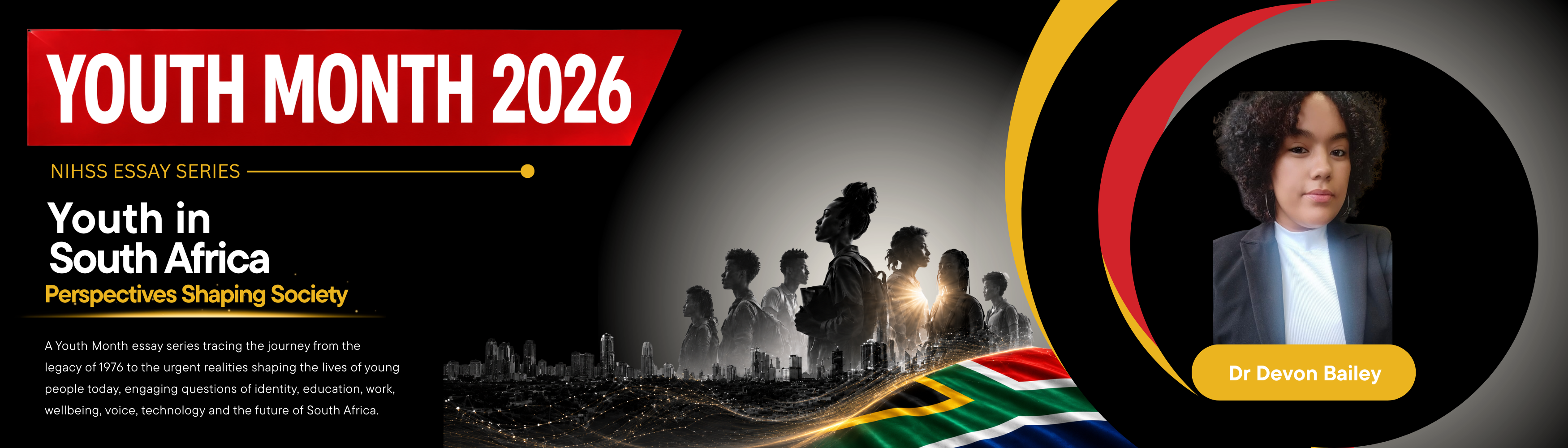
Youth in South Africa (Youth, Identity, and Belonging)
In the spirit of youth month, I write this opinion piece to reflect on the lived realities of coloured youth living in coloured townships across South Africa. This piece investigates the connections between identity (and the lack thereof), and the lived reality of coloured youth through Charles Taylor’s concept of misrecognition. I conclude that reintegrating sports and arts in schools and as community projects, such as dance, provides an alternative opportunity to form an identity outside of the social ills consuming coloured communities.
According to Charles Taylor (1994), one’s identity, shaped by race, sex/gender, economic status, religion, geographical location, aesthetic preferences, political affiliation to name a few, can be understood within the framework of recognition and non/misrecognition. He claims that the way we form our identities is based largely on whether and how people are recognized for their inherent human dignity. This is significant because Charles Taylor (1994) argues that the recognition of the individual is in the hands of those who (mis)recognize them. It is the unfortunate reality that coloured youth are often on the receiving end of misrecognition, both by their fellow South Africans, and the state alike.
The lived realities of coloured youth in South Africa include economic exclusion, gun and gang violence, drug and alcohol use, teenage pregnancy, exposure to harmful situations, such as public substance use and domestic violence. Consequently, crime in coloured communities thrives on lost, mislead, underrepresented, misrecognized youth full of potential and nowhere to direct their energy. The relegation of the significance of coloured youth in South Africa is evident in the need to assert their place in the world through violence, especially considering gang and gun violence in coloured townships across South Africa. Coloured youth are misrecognized in the sense that they are often economically excluded, leaving them with few options, opportunities, and little hope for anything close to a dignified or fulfilling life.
As such, it is my claim that coloured youth are only doomed to the lack of opportunities and resources available for them to thrive. Schools in coloured townships in South Africa seldom provide extra-curricular activities, coloured townships are underfunded to the extent that they rarely have libraries, recreation centres, sports or arts activities in which the youth can engage. Growing up as a teenager in Eldorado Park, I thrived on being part of a dance crew called “B-Supreme,” a crew of dancers who used to practice together at the local community (Don Mateman) hall. Dance, as a social activity and performance art provided the platform for me to construct an identity beyond what my surroundings offered me, which were a lot less dire than they are now.
Currently, dance companies in Eldorado Park such as So-Dope Dance Academy, lead by the talented and passionate Tarryn Alberts, and No Limits Academy, lead by Jonathan Retief provide the youth with an opportunity to use dance to assert their presence in the world. Dance provides a framework for the forming of an identity that transcends the lived realities of coloured youth in South Africa (Mullis, 2016). In a previous paper, I argue that breakdance creates an environment in which the dancer forms their identity based on their physical capacity to practice, master, and execute dance moves (Bailey, 2021). As such, dance provides a proverbial way out, a means of transcending one’s lived reality (albeit momentarily), and a framework for the construction and formation of an identity and sense of belonging outside of the confines of the lived realities of coloured youth in South Africa.
References
Bailey, D. (2021). “Self-knowledge through Dance: Considering the Female Breakdancer in South Africa.” In African Somaesthetics: Cultures, Feminisms, Politics, ed. Botha, Catherine (Leiden, Boston: Brill), pp. 120-142.
Mullis, E. (2016). “Dance, Philosophy, and Somaesthetics.” Performance Philosophy, Vol. 2, No. 1, No. 60-71.
Taylor, C. (1994). “The Politics of Recognition.” In Multiculturalism: Examining the Politics of Recognition. Edited by Amy Gutmann. Princeton: Princeton University Press.