


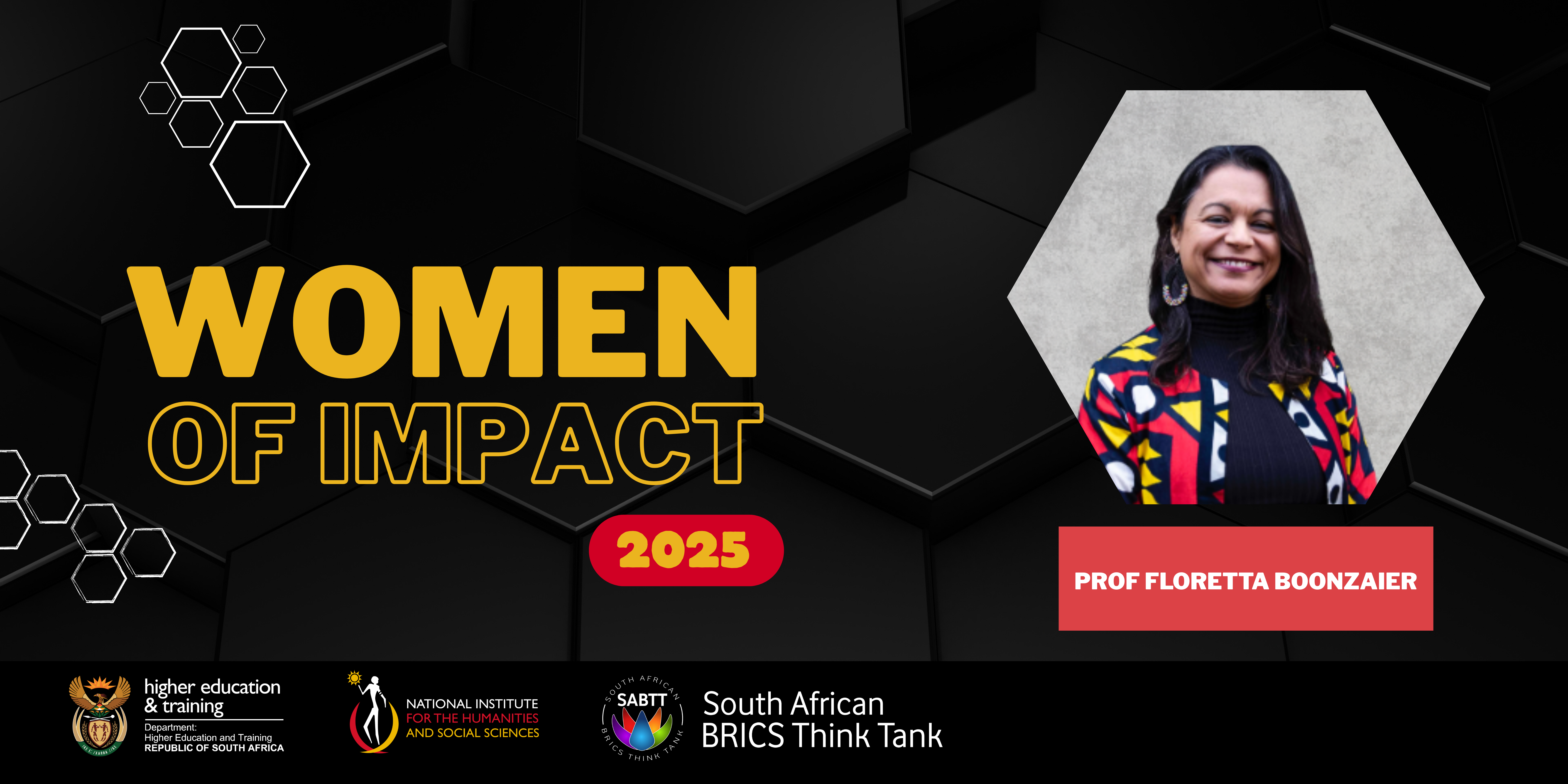
In celebration of Women’s Month 2025, the National Institute for the Humanities and Social Sciences (NIHSS) proudly continues its Women of Impact series, honouring the remarkable women shaping South Africa and the world through knowledge, research, leadership, and care.
1. How is your work shaping a better future through the Humanities and Social Sciences?
I am an established international expert on GBV, identity and decolonial feminism. I have delivered keynotes for international audiences and received several scientific awards, including two fellowships to Harvard University. In 2010 I received the runner-up award for the South African Department of Science and Technology’s Women in Science Awards for the category, Distinguished Young Woman Scientist and in 2022 I received a runner-up award in the Distinguished Woman Scientist category. I received a B2 rating from the National Research Foundation which indicates that I am “a researcher who enjoys considerable international recognition (from my) peers for the high quality and impact of (my) recent research outputs.” I formally established The Hub for Decolonial Feminist Psychologies in Africa as founding co-Director in 2018, at Africa’s leading university (UCT). Here, I continue to lead important transdisciplinary studies shaping the field globally.
I have authored over 85 peer-reviewed publications, including papers in leading international journals. My research findings have contributed to advancing gender equality through explorations of best practices in working with men to end GBV; through working in partnership with organisations in the GBV sector and through development of conceptual models to drive policy and practice, including through work with the Office of the South African Presidency.
Over my career, I have played an important role in growing the next generation of scholars through the capacity development of students and other researchers, successfully mentoring three postdoctoral fellows, and supervising the completion of 11 PhDs and over 30 master’s students. I have attracted international doctoral students who undertake doctoral studies in South Africa, specifically to work under my supervision and mentorship. I also serve as a regional doctoral mentor for the National Institute for the Humanities and Social Sciences in South Africa. I frequently act in a mentoring role to new and emerging researchers, including colleagues in my department, and over my career have played an important role in mentoring fellow black women academics. I am currently a mentor to UCT’s Next Generation Professoriate Programme with the aim of growing the next generation with a focus on black women academics in the professoriate. I am also a mentor to a colleague in UCT’s Research Leadership Programme for women.
Co-founding the Hub for Decolonial Feminist Psychologies in Africa in 2018 has significantly shaped the discourse and direction of questions of knowledge production in psychology (and beyond), locally and internationally. The Hub has gained an international reputation for the work it does (with increasing demand for collaborations), and it is currently also a member of the International Research Association of Institutes of Advanced Gender Studies (RINGS).
Using my professional expertise to be of service to the wider community, I have served on the board of Rapcan (Resources Aimed and the Prevention of Child Abuse and Neglect) and currently serve on the Board of Mosaic Training, Service and Healing Centre for Women. I have been invited for numerous media, film and other interviews to speak on the topic of advancing gender equality through ending GBV. Alongside this work, I have also worked with the Office of the Presidency of South Africa to take the lead in producing a report that articulates what a decolonial feminist approach to violence against women and girls in Africa should look like. The report is being used toward shaping funding, policy, and other agendas in the sector, both nationally and regionally.
2. What drives your passion, and what change do you hope to create?
The most rewarding and exciting aspect of my career as an academic has been my engagements with students through mentoring and supervision. I find close supervision of student research work most rewarding, and I frequently work with student supervisors in a mentoring role toward developing their careers as young scholars and encouraging them to publish the research they have been engaged in. I work hard to ensure that students I work with are provided prospects to access research funding and opportunities to present their work at national and international forums. I have often included students in research collaborations and introduced them to my own scholarly networks as I believe that an academic training should go well beyond discussions of the research project that occurs in the supervisor’s office. In feedback from my students over the years, many have expressed their gratitude for the more comprehensive mentoring role that I have played in the development of their academic careers. I see all of my students, those I teach across undergraduate and postgraduate years and those I work more closely with in supervision, as scholars-in-training and I respect the knowledges they bring to the supervisory/teaching relationship we establish.
Having experienced all the challenges and opportunities of entering the university space as a black woman, first-generation university graduate. I understand the complexities of navigating alienating university environments, especially in terms of the complexities of race and gender and the exclusions they create.
Given this context, I have been most rewarded by working with younger academics around their own career trajectories and the possibilities for their advancement in the university.
I have been working hard to build and create safe, inclusive spaces for black and marginalized students and colleagues. My passion is to build safe, inclusive spaces to counter alienation and a lack of belonging in academic environments that are often harsh, dehumanizing and that operate in authoritarian ways. To counter these challenges building healthy research and other communities are essential. We need to ensure that these spaces offer care, community and opportunities for collaboration.
In work that has been done by myself and my research community we have come to recognise that ensuring a healthy research community and environment involves recognising each member of the community as a human, having space for their identity, struggles, and emotions alongside their ideas. We recognise that this culture is not just about the ways in which we treat each other but also about the ways in which we actively resist ongoing violences where possible. In my own practice, of supervision, collaboration, teaching and building community, I have endeavoured to model an ethical, careful and loving approach to academic practice. In many of our spaces we have begun conversations around the concept of ‘decolonial feminist love’ offering this conceptualisation to a space (academia) that frequently involves hostility, competitiveness, exclusion and alienation. We know that university spaces are not separate from the societies in which they exist and as a result the structural racism that is the legacy of apartheid and colonialism in South Africa infiltrates our experiences every day. Fostering a positive research, work and university environment is an ongoing endeavour.
3. How can mentorship contribute to dismantling barriers faced by women in research and academia?
Careful and ethical mentoring is essential for dismantling barriers faced by women in academia. In such mentoring relationships it is important to be mindful of the similar and different experiences of both the mentees and mentors and their differing intersecting identities they may bring to the relationship. These kinds of mentoring relationships can be essential for women’s advancement – being able to see your own experiences having been reflected in your mentor’s history may offer you a valuable opportunity and insight to see a future pathway for yourself in academia – having realised that they have successfully treaded the path you hope to walk yourself. Receiving guidance and care from someone who understands the reality of the harshness of academic environments and the multiple demand places on us (especially women) in academia can go a long way to feeling seen and heard and provide opportunities for finding ways to resist. Mentoring can go a long way to enabling women to see themselves as future leaders in their respective fields.