


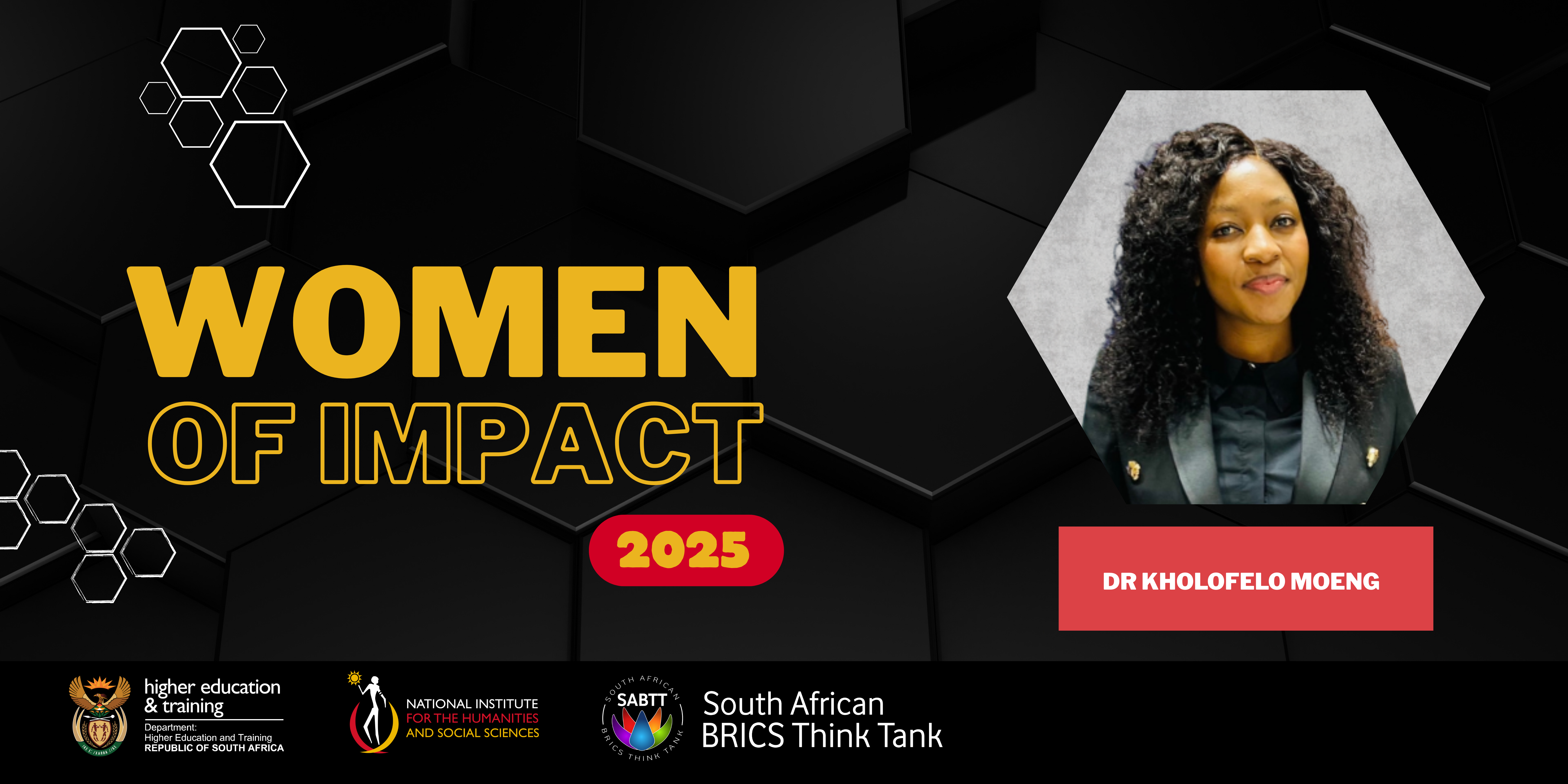
In celebration of Women’s Month 2025, the National Institute for the Humanities and Social Sciences (NIHSS) proudly continues its Women of Impact series, honouring the remarkable women shaping South Africa and the world through knowledge, research, leadership, and care.
1. How is your work shaping a better future through the Humanities and Social Sciences?
My work explores the Just Transition to a low-carbon economy, focusing on the opportunities and challenges it presents for communities in the coalfields. The Just Transition represents one of the most crucial responses to the global crisis of climate change. Although it offers promising prospects for greening the economy, it also poses significant challenges that risk deepening existing injustices and inequalities for others. By interrogating the Just Transition through an interdisciplinary theoretical lens, my work engages with the complex historical, present, and future non-linear dynamics that underpin the Just transition. To meaningfully situate these issues within the lived realities of marginalized and impoverished populations, my research moves beyond Eurocentric epistemologies. It adopts a decolonial environmental justice framework to center voices and experiences of these marginalized communities. This approach is essential to advance a Just Transition that is genuinely inclusive, equitable, affordable, and socially just.
2. What drives your passion, and what change do you hope to create?
My passion is rooted in a deep commitment to social justice. Too often, the poor are systematically marginalized and rendered voiceless, bearing the harshest burdens of development models that claim and promise to uplift them, only to entrap them in perpetual injustice and poverty. Through my scholarship, I aim to pose critical questions, interrogate and challenge organized systems that perpetuate marginalization. Beyond research, I am intentional about engaging in spaces that foster meaningful dialogue and collective action—spaces that strive to amplify the voices of those rendered powerless and voiceless and to support efforts toward their empowerment and emancipation.
3. What does the celebration of Women’s Month mean to you?
Women bear the harshest reality of entrapment and marginalization. Despite possessing immense potential to transform the circumstances of their families and communities, they are frequently systematically rendered powerless. Therefore, for me, the celebration of Women’s Month mean, we are cognisant of this reality and are committed to move beyond festivities and conversations to real emancipation and empowerment of women through deliberate efforts and actions to equip them with the skills, knowledge, and access to opportunities they need to thrive. This is a vital and bold step toward breaking the cycle of poverty.