


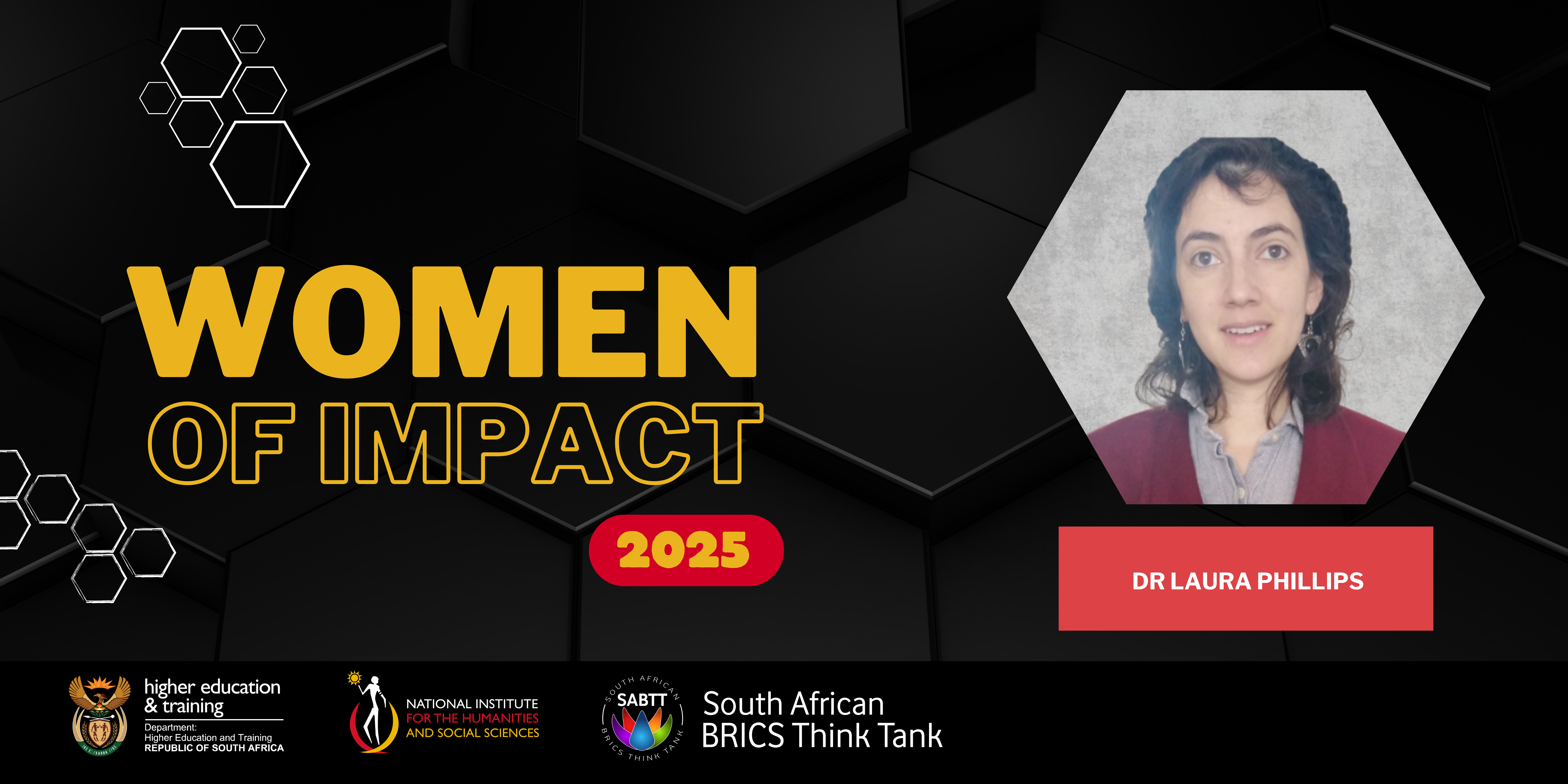
In celebration of Women’s Month 2025, the National Institute for the Humanities and Social Sciences (NIHSS) proudly continues its Women of Impact series, honouring the remarkable women shaping South Africa and the world through knowledge, research, leadership, and care.
1. How is your work shaping a better future through the Humanities and Social Sciences?
Nurturing the skills of historical analysis may seem like a modest achievement, but teaching students to think historically – which is to say, understanding change over time, denaturalizing the categories that we have come to take for granted, connecting evidence to theory – makes a dramatic difference to the next generation and our ability to function as a society. It is these skills that sharpen social and political analysis while also guarding against many of the bigotries that give rise to thinking of social hierarchies as natural. As part of my NIHSS grant project and the broader work I do at Wits, I supervise postgraduate students. While my students work on a range of different topics, they leave my supervisory care not only with a postgraduate degree and expert knowledge, but a skillset they can apply to any number of circumstances they find themselves in.
2. What drives your passion, and what change do you hope to create?
I am fascinated by the way that the economy has become ‘dis-embedded’ from society. As Karl Polanyi once argued, there is nothing natural about a distinct economic sphere, where market forces are divorced from issues that we typically categorise as social or cultural. Understanding this process drives my research into African economic history, trying to parse out the historical developments that lead to shifts in economic thought, practice and policy. Conceptualising the economy in this way is at odds with the much of the mainstream analysis and as such, offers a vision of society untethered from some of the constraints placed by the imperatives of free-market exchange.
3. What does the celebration of Women’s Month mean to you?
On the one hand, because I’m a historian and very committed to empirical specificity, I care a lot about the 9 August 1956 march to the Union Buildings. Women’s challenge of the pass laws was immensely significant not only in resisting apartheid, but also in what were quite male-dominated liberation movements. On the other hand, I live in 2025 and recognise the danger of a world that discounts the importance of gender in shaping the economy, politics, culture, and society more broadly. To me, Women’s Month is a reminder of our history, but also the urgency of keeping ‘gender’ as a lens through which to understand and analyse our world and its many problems.