


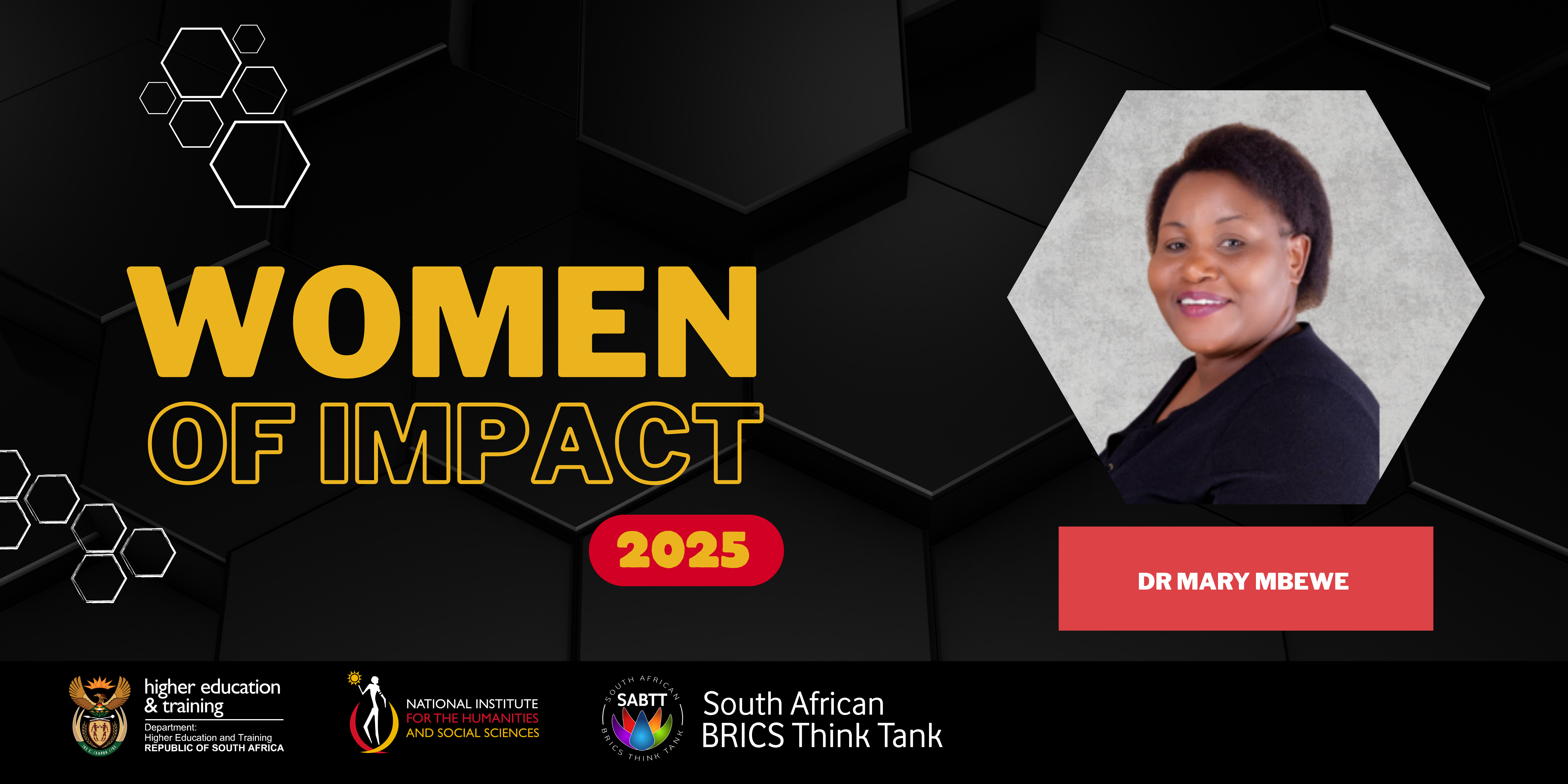
In celebration of Women’s Month 2025, the National Institute for the Humanities and Social Sciences (NIHSS) proudly continues its Women of Impact series, honouring the remarkable women shaping South Africa and the world through knowledge, research, leadership, and care.
1. How is your work shaping a better future through the Humanities and Social Sciences?
My work contributes to shaping a better future through the Humanities and Social Sciences by critically engaging with the legacies of colonialism and their impact on cultural heritage, museums, and public memory. I examine how collections made under colonial times can be reimagined in ways that foster dialogue, bridge divides between different forms of knowledge, and support more equitable cultural representation.
A key part of my research and advocacy focuses on the restitution of African museum objects and art held in European institutions. I investigate the historical contexts in which these collections were created, often through exploitative colonial processes, and collaborate with communities, scholars, and museum professionals to advance ethical frameworks for their return. This advocacy is grounded in the belief that restitution is not only about the physical transfer of objects but also about restoring dignity, agency, and cultural continuity to the communities from which they came.
I also explore postcolonial efforts to rethink colonial museum collections and exhibitions, asking how they can be transformed into spaces for dialogue, learning, and repair. My research highlights practices that challenge dominant colonial narratives, incorporate community voices, and experiment with curatorial approaches that acknowledge multiple perspectives. By rethinking the interpretation and display of these collections, I aim to contribute to museums becoming spaces that engage critically with history while fostering social justice and cultural understanding.
Through this work, I bring African and European perspectives into conversation, promote mutual understanding, redress historical imbalances, and inspire approaches to heritage and history that empower rather than exclude. In this way, my scholarship not only interrogates the past but also contributes to building a more inclusive and reflective future.
2. What drives your passion, and what change do you hope to create?
My passion is driven by a deep commitment to confronting and transforming the enduring legacies of colonialism in museums, cultural heritage, and knowledge production. I am constantly inspired by being part of an immensely committed, determined, and hardworking community of African and international scholars who are dedicating their energy and expertise to this work. Their creativity, courage, and persistence in pushing boundaries and challenging entrenched narratives energise me every day. Seeing their research, advocacy, and achievements make a tangible difference fuels my own determination to contribute, to keep asking difficult questions, and to work toward a future where cultural heritage is cared for, interpreted, and shared in ways that are just, inclusive, and transformative.
3. What does the celebration of Women’s Month mean to you?
The celebration of Women’s Month is, for me, both a moment of recognition and a call to action. It is a time to honour the resilience, creativity, and leadership of women past and present, whose contributions have shaped our societies often in the face of exclusion and systemic inequality. It is also a reminder that the struggle for gender justice is ongoing and that progress requires persistence, solidarity, and the courage to challenge deeply rooted structures of power.
As a scholar working in fields historically dominated by particular narratives and perspectives, Women’s Month reinforces my commitment to amplifying women’s voices and experiences, both in the histories I research and in the communities and institutions I engage with. It is an opportunity to celebrate the achievements of women who have paved the way, to acknowledge those who continue to break barriers, and to inspire future generations to imagine and work toward a more equitable world.
For me personally, it is also an opportunity to deliberately remember and celebrate my own achievements as a woman and as a person, to pat myself on the back and say, “you did it, woman!” Sometimes so much is expected of us that we forget to pause, breathe, and say, “I got here!” Taking that moment of self-recognition is not just empowering, it is essential.